Delivered a 360° digital product build for Z Solution UK—designing UI/UX, developing scalable mobile & web apps, engineering data pipelines and BI, and deploying secure cloud infrastructure. Result: faster releases, reliable performance, and insight-driven decisions.
Services provided:
In partnership with:
Client industry:
Client location:
The customer is running a legacy, on-premise ERP platform that has become a bottleneck for day-to-day operations and future growth. As user demand increases and new business requirements emerge, the current environment struggles to scale without expensive hardware upgrades, complex capacity planning, and long lead times. Performance is inconsistent—peak business hours can cause slow transactions and delayed reporting—while system availability depends heavily on manual intervention and limited redundancy.
In addition, the customer’s data landscape is fragmented. Operational data, reporting data, and historical records are spread across different databases and file shares, making it difficult to maintain a single source of truth. This fragmentation reduces business visibility, slows decision-making, and increases the effort required for analytics, audits, and monthly closing activities.
Security and compliance are also major concerns. The existing setup lacks modern controls for identity, encryption, and centralized monitoring, creating gaps that elevate operational risk. For UK/EU workloads, GDPR requirements add further pressure: the customer must ensure secure handling of personal data, clear access controls, auditability, and predictable data residency.
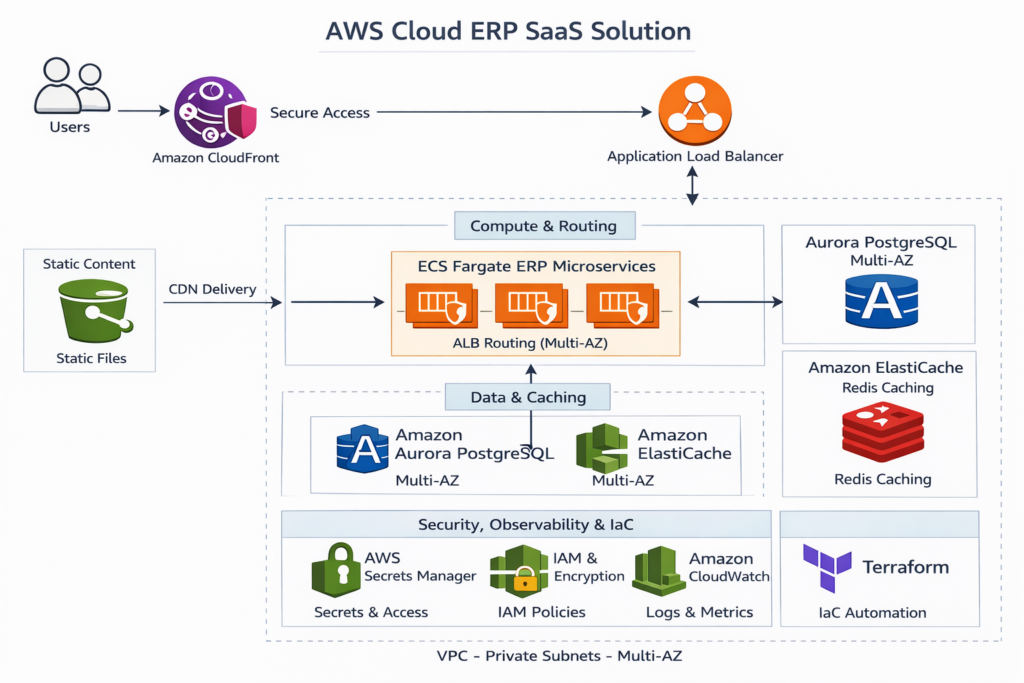
We modernized the ERP into a cloud-native SaaS platform on AWS (UK/EU region) designed for high availability, security, and elastic scale while meeting GDPR-aligned data residency and controls.
1) Hosting & Compute Layer
• Amazon ECS on AWS Fargate runs the ERP backend as containerized microservices (no server management).
• Auto scaling adjusts service capacity based on demand (CPU/memory/requests).
• Application Load Balancer (ALB) distributes traffic across multiple Fargate tasks for resilience and performance.
2) Data Layer
• Amazon Aurora PostgreSQL (Multi-AZ) provides a managed, resilient relational database for core ERP data.
• Automated backups, point-in-time recovery, and maintenance handled by AWS to reduce operational burden.
3) Web & Static Content Delivery
• Amazon S3 stores static assets (frontend builds, documents, exports, invoices, attachments).
• Amazon CloudFront accelerates global delivery with caching and edge locations, improving UI load times and user experience.
4) Performance & Caching
• Amazon ElastiCache (Redis) is used for:
o session/token caching
o frequently accessed ERP reference data
o reducing database read load and improving response times
5) Security, Identity & Secrets
• AWS Secrets Manager securely stores and rotates credentials (DB passwords, API keys).
• IAM roles and least-privilege policies control service-to-service access.
• Encryption at rest and in transit (TLS) with optional AWS KMS for key management.
• Optional hardening: AWS WAF in front of ALB/CloudFront, plus Security Groups + NACLs for network control.
6) Networking & Availability
• Amazon VPC with public and private subnets across multiple Availability Zones:
o ALB in public subnets
o ECS services and Aurora in private subnets
• Multi-AZ architecture ensures continuity during AZ-level issues and minimizes downtime.
7) Observability & Operations
• Amazon CloudWatch for:
o application/service logs
o metrics and dashboards (latency, errors, CPU/memory)
o alarms for proactive incident response
• Optional: centralized tracing/log analytics extensions as needed.
8) Infrastructure as Code (IaC)
• Terraform provisions and manages the full stack:
o repeatable environments (dev/test/prod)
o controlled changes via versioning
o faster deployments and standardized governance